Elementary Training
Where technique begins. For boys and girls aged 7 to 10.
Where technique begins. For boys and girls aged 7 to 10. One hour on Tuesdays, or two and a quarter hours if they also come on Thursdays. No audition: at this level, everyone starts at the barre.
The essentials
Age: 7 – 10 years · Registration fee: 65 € · Audition: No · Days: Tue · Schedule: 18:30 – 19:30 · Monthly fee: 45 €
Age: 7 – 10 years · Registration fee: 65 € · Audition: No · Days: Tue · Thu · Schedule: Tue 18:30 – 19:30 · Thu 18:30 – 19:45 · Monthly fee: 80 €
The classical foundation
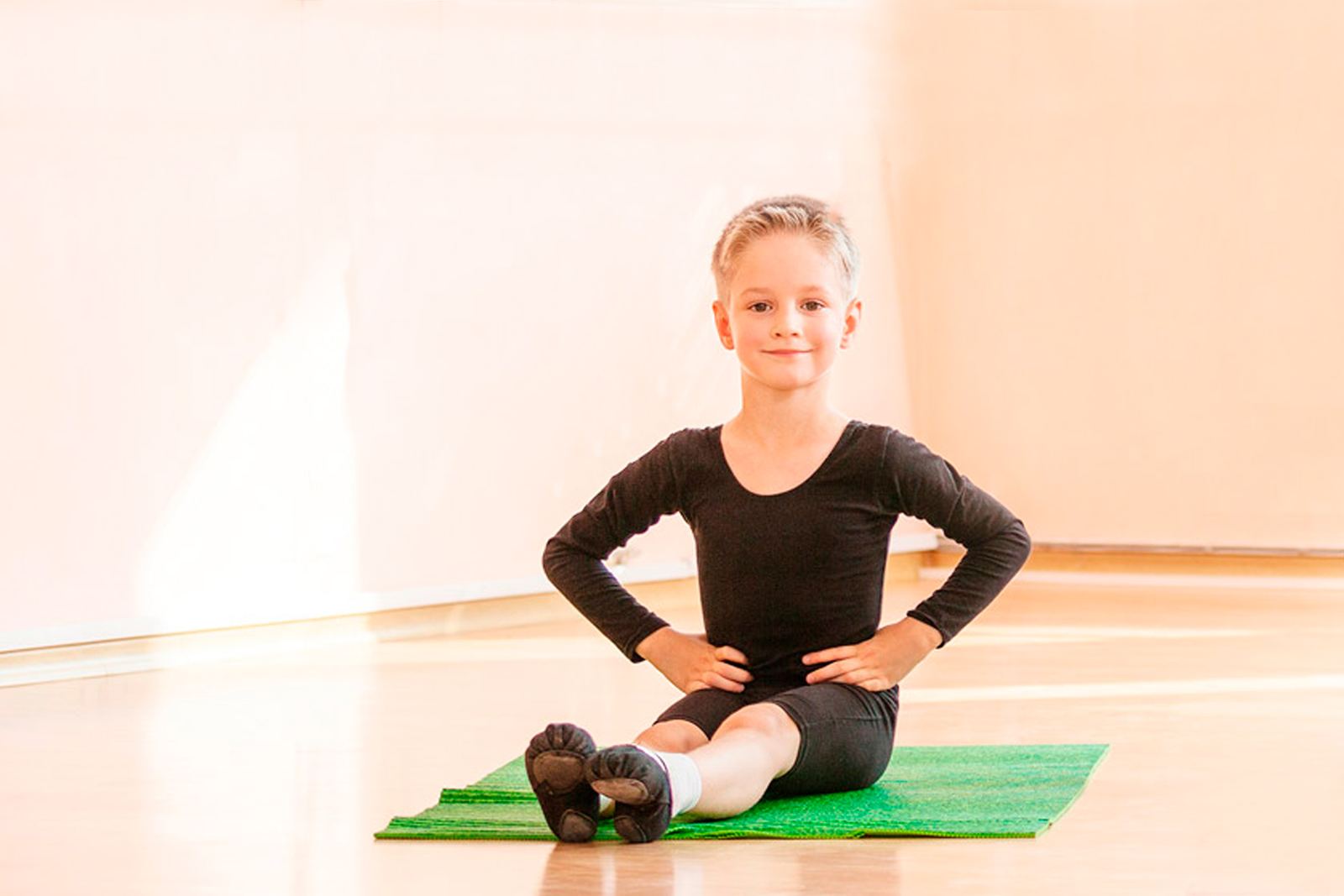
At Elementary level, ballet stops being a game that teaches and becomes a technique to be learned. Class moves to the barre, the vocabulary becomes French, and every exercise has a name, an order and a correction. The aim is the one this school has always stated: a healthy, musical dancer.
- 01
What they learn
First comes placement: where the weight falls on the feet, how the back is held, how the leg turns from the hip and not from the knee. Then the vocabulary (plié, tendu, dégagé, rond de jambe) and the port de bras that carries the arms through it all.
- 02
How it's taught
Through repetition and correction. The same exercise returns every week, a little longer and a little harder. Correction is not a reproach: it is the content of the class. And at this age a child can already hold a long sequence in their head, so the sequences grow throughout the year.
- 03
Where it leads
It leads to Professional Training from the age of ten: class, repertoire and, from twelve, the first pointe shoes. What Elementary has to deliver is correct alignment, a broader vocabulary and combinations a dancer can remember.
Professional Training
One stage, twice a year
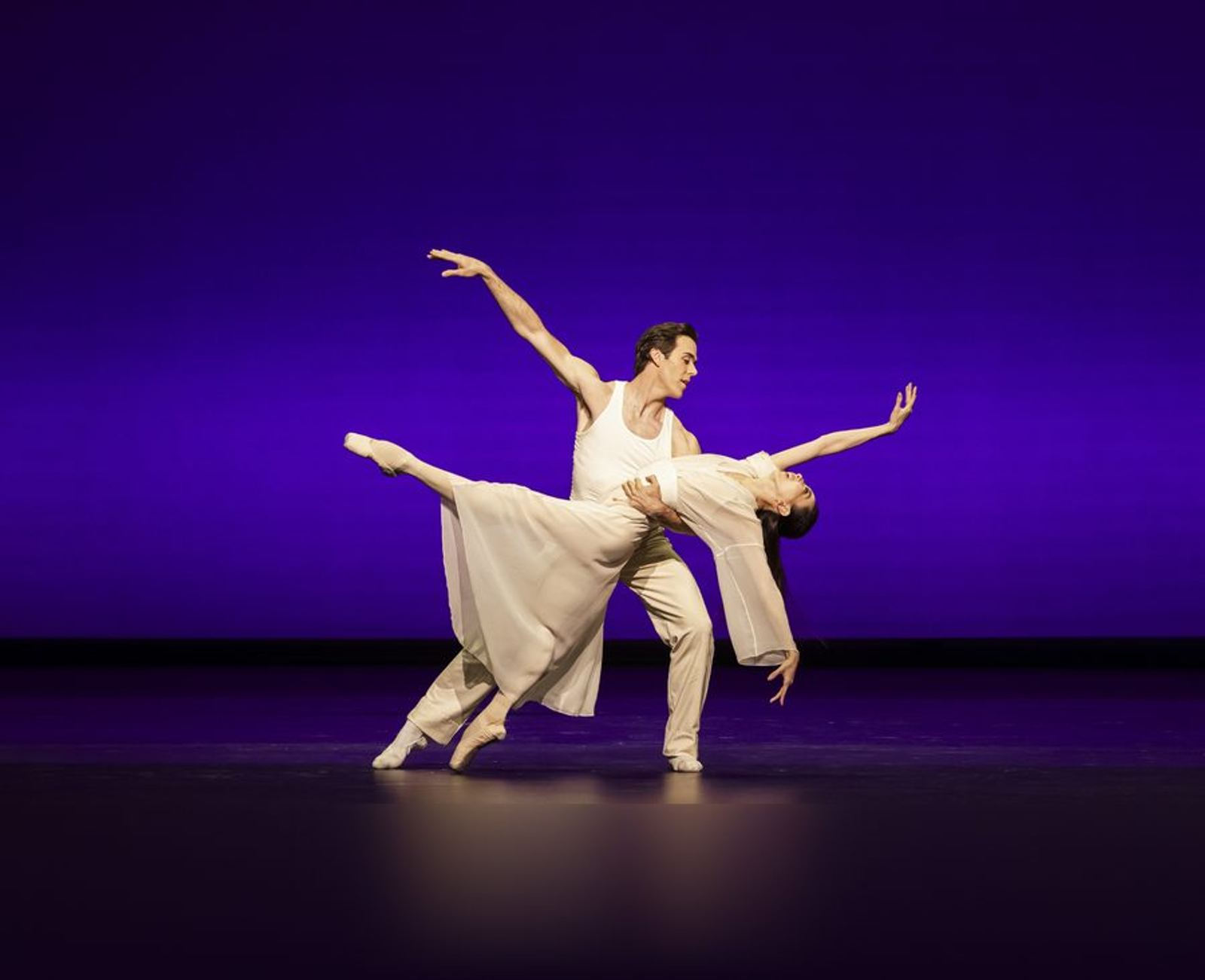
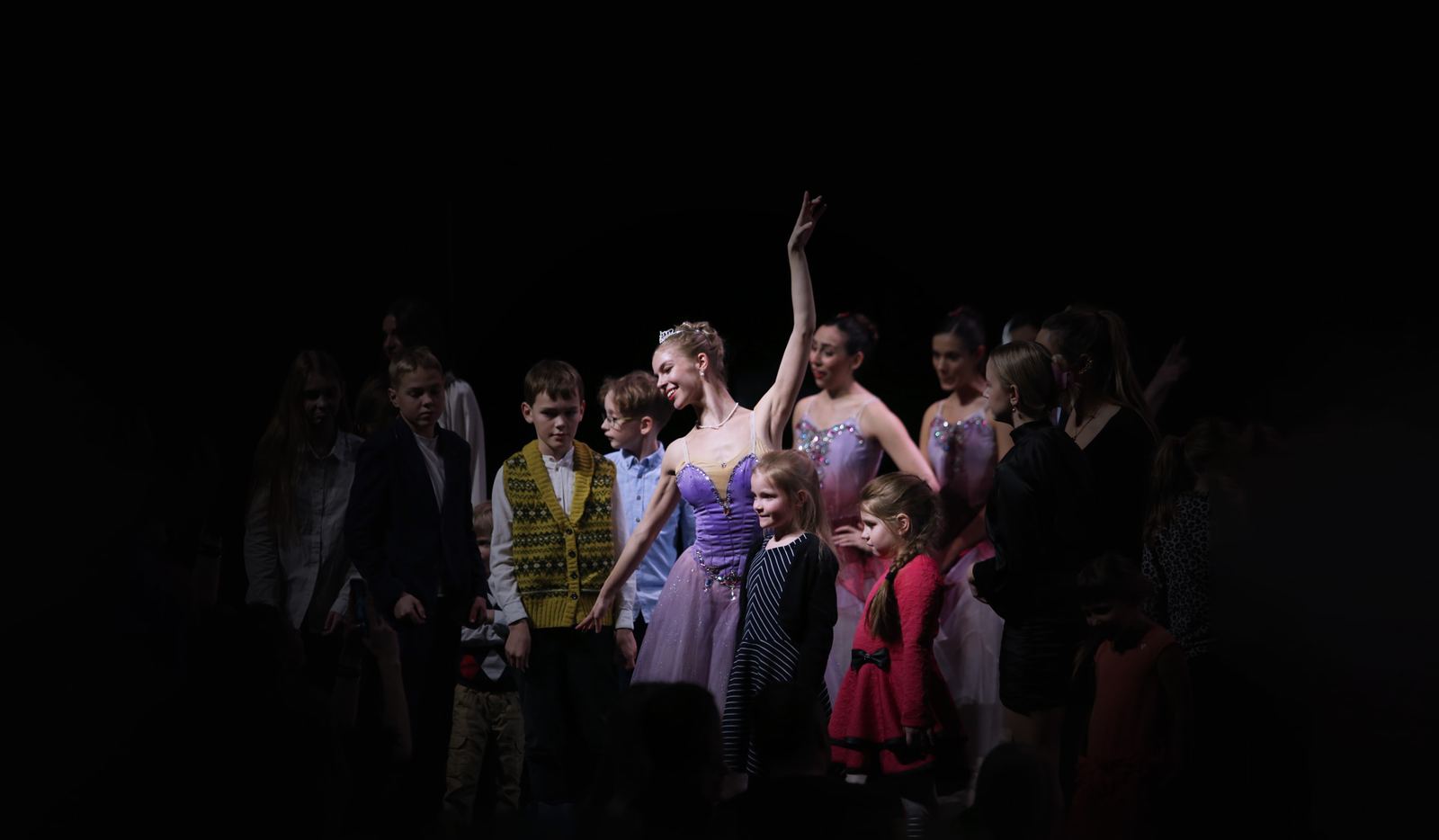
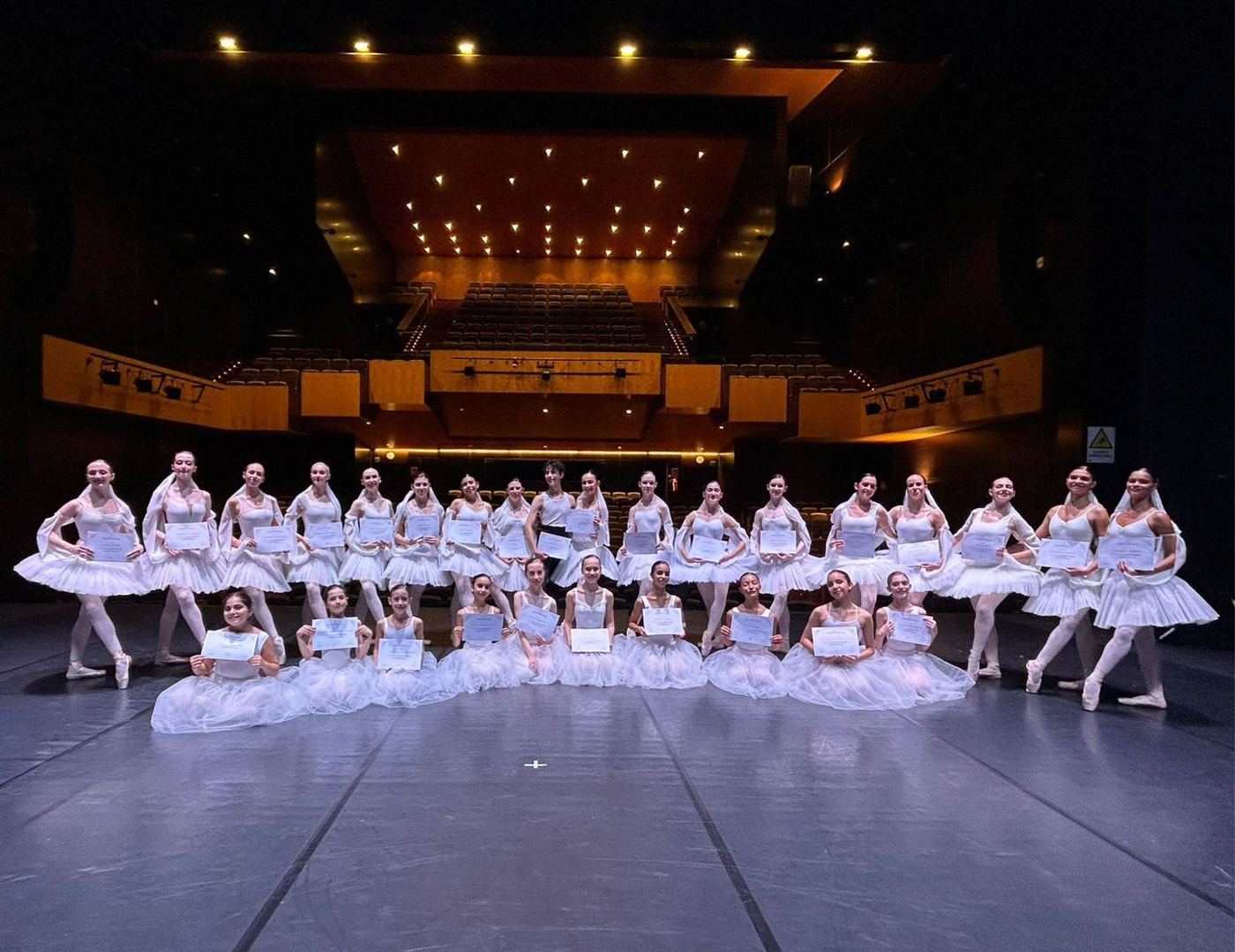
The whole school performs at the Auditori de Terrassa: El Cascanueces, the school's own production, in December, and the end-of-year show in June. For an Elementary student, these are their first real repertoire pieces, learned over many months and danced before a full house.
What a class looks like
The order never changes, and it is the same one used in ballet schools all over the world. It is not tradition for tradition's sake: each part prepares the body for the next.
- 01
The Barre
First with both hands, then with one. Pliés to open up the joints, tendus to teach the foot to leave the floor and return to it. The barre is not something to hold on to: it is where the body learns what it will later do on its own.
- 02
The Centre
The same work, without support. Here a shape becomes a shape that holds itself: balance, épaulement, the first slow adagios.
- 03
The Diagonal
Travelling steps and linked jumps: allegro. Direction, timing, and landing in silence, which is far harder than jumping high.
- 04
The Reverence
Class closes with the reverence. It is a courtesy, and it is also the moment a child registers that the hour is over and that something has been built inside.
What These Years Are For
Between seven and ten is the age when a child can learn something difficult on purpose: hold a long sequence, accept a correction, repeat something until it changes. A ballet class asks all of that of them every week, and gives back more than technique.
None of this is taught as a subject. It is taught as a ballet class.
- 01
A Body That Grows Fast
Between the ages of seven and ten, a child grows quickly and not always evenly, and the way they stand is still being settled. Hours at a desk and a heavy school bag all pull in the same direction.
In the studio: every barre exercise is, underneath, postural work: where the weight falls, how the back is held, how the leg turns from the hip and never from the knee. The habit is built while the body is still deciding.
- 02
Memory That Holds a Sequence
This is when a child becomes able to hold a long chain in their head: an order, with its own logic, learned once and remembered afterwards.
In the studio: nothing is written down. Combinations grow longer over the course of the year and are given only once, in words and in music. It is the body that remembers them.
- 03
Being Corrected, and It's Fine
Learning that a correction is information and not a verdict is one of the hardest things at this age, and one of the most useful, in the classroom and beyond.
In the studio: the teacher corrects out loud, in front of everyone, in every class. The children learn to take it in, use it and keep dancing. It stops stinging sooner than you would expect.
- 04
A Vocabulary That Is a Language
Ballet gives a name to each of its movements, and the names are French and precise. Being able to name exactly what you are doing is where thinking about it begins.
In the studio: by the end of the year a child knows dozens of terms and what each one asks of the body. They learn foreign vocabulary because they need it, which is the only way anyone ever learns it.
- 05
The Group as One Body
In a class everyone moves at once, to the same music, in the same direction. Nobody wins. What there is is a result that only exists if each person holds up their part.
In the studio: a dancer out of time can be seen from across the room. They learn to look, to listen and to adjust, and to be proud of something that belongs to the group and not to them alone.
- 06
Fractions, Danced
Music in three and music in eight. An exercise at half speed, at double speed, in reverse. Everything to the right and then mirrored to the left, which is symmetry with a body inside it.
In the studio: they count a waltz against a march, take a phrase and do it at half speed, and reverse a combination they learned going forward. Fractions, symmetry and pattern, danced years before they are studied.
The Teachers
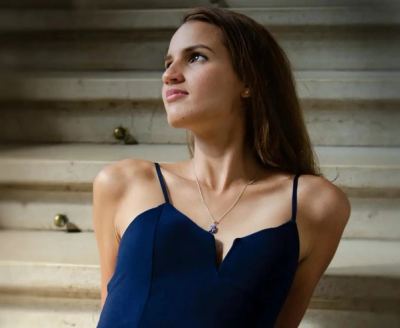
Arasay Toledo
Pre Ballet and Elementary Training
School of the National Ballet of Cuba
The 2026 / 2027 School Year
Classes run from September to June, following the school calendar. These are the dates families need to have in their diaries.
- DecemberOpen DayFamilies come into the studio and watch a class from the inside.
- 12 DecemberEl CascanuecesThe school's own production, at 18:00 at the Auditori de Terrassa. All the school's groups take part.
- MayOpen DayA second class open to families, near the end of the school year.
- 25 June 2027Classes EndThe last regular class of the school year.
- JuneEnd-of-Year PerformanceThe big one: the whole school on the stage of the Auditori de Terrassa.
What families need to know
There are few rules, and they are the same for every group in the school. They exist so that an hour of class is truly an hour of class.
Uniform
The uniform supplier is being confirmed for this school year. The school will say who it is, and where to buy it, before classes begin.
Leotard: the school uniform leotard. Tights: pink. Shoes: soft ballet shoes. Pointe shoes are not introduced before the age of twelve, so they are not used at this level. Skirt: the uniform skirt, for repertoire. Boys: white T-shirt, black tights and black soft ballet shoes. Hair: classic bun, high or low, with no loose fringes.
(The supplier is the same for Pre Ballet, Elementary and the pre-professional programmes.)
What to Bring
Four things in the bag, at every class.
Water: a bottle with their name on it. Uniform: complete, and already on when they arrive. Bun kit: hair elastic, pins and hairnet. Spare clothes: for the youngest, if you think they will be needed.
In the Studio
The studio has few rules, and they are the same for all the school's groups.
Ten minutes early: Arriving early is part of the class: it is the time to change, put your hair in a bun and settle down. Warm up beforehand: Warming up happens before the class begins, not during it. A class under way: It is not interrupted. If you arrive late, wait for the teacher to give you a signal. Ready on arrival: Uniform on and hair done before entering the studio. Respect: For the teacher, classmates and equipment. Appropriate language. Phones: They stay outside the studio during class.
Attendance
At this level the class builds on itself: an exercise given in October is still being corrected in March. Missing weeks show.
Let us know: tell the school when your child will not be coming. Eighty per cent: the attendance we recommend in order to take part in performances and assessments.
Communication
Constant communication with families is one of the school's stated values, and this is how it works in practice.
WhatsApp group: an information group for the class, with everything important also sent by email. Start-of-year meeting: 10 September, before classes begin. Individual tutorials: with the teacher, whenever needed; either you ask for them or we do. Progress report: twice a year, with the tutor. Photographs: class photos and videos are only published with the authorisation that families sign before the year begins.
Schedule and fees
The same class and the same group: what changes is how many times your child dances each week.
Registration fee: 65 €, once per school year; non-refundable. Discounts for siblings, annual payment and large families apply at enrolment.
One day per week
45 € per month
Tue · 18:30 – 19:30
- One class per week
- Enough to learn the class and follow the year
- No audition
Two days per week
80 € per month
Tue 18:30 – 19:30 · Thu 18:30 – 19:45
- The second class is where a correction is repeated before it is forgotten
- It is the weekly rhythm of the pathway that follows
- No audition
Try a class first
A ballet class is much easier to understand from the inside: your child takes one with their group, and then you decide together.
Tell us their age, whether they have danced before and which day suits you (Tuesday or Thursday): we will place them in a class that same week.
Payment is by card when booking. The school office arranges each trial class by phone, WhatsApp or email.
Before you ask
When do they start pointe work?
Not in Elementary. At Ballet de Catalunya, pointe work begins at the age of twelve: it is a school rule, not a decision made child by child. Before that age the bones of the foot and ankle are still forming, and going up on pointe too early can cause damage that cannot be undone. It is not brought forward for anyone, however talented or eager, and it begins within the pre-professional pathway.
Can my child start at nine without ever having danced?
Yes. Elementary accepts beginners across the whole age range. Call us, come along to a trial class, and the teacher will tell you frankly whether this group or another is the right fit.
Is there an audition?
No. Elementary has no audition or entrance test.
My child has done Pre Ballet. Do they move up automatically?
Yes, at seven. It is the same school and the same teacher, and the move up is built in.
Are there exams?
Not at this level. Formal assessment begins with the pre-professional programmes. What we offer here is a progress report twice a year with the tutor, and an individual tutorial whenever either side asks for one.
Is the registration fee refundable?
No. The registration fee is paid once per school year and is non-refundable.
What if Tuesdays don't work for us?
Elementary takes place on Tuesdays, with the second hour on Thursdays. These are this group's days; other programmes at the school run on other days.
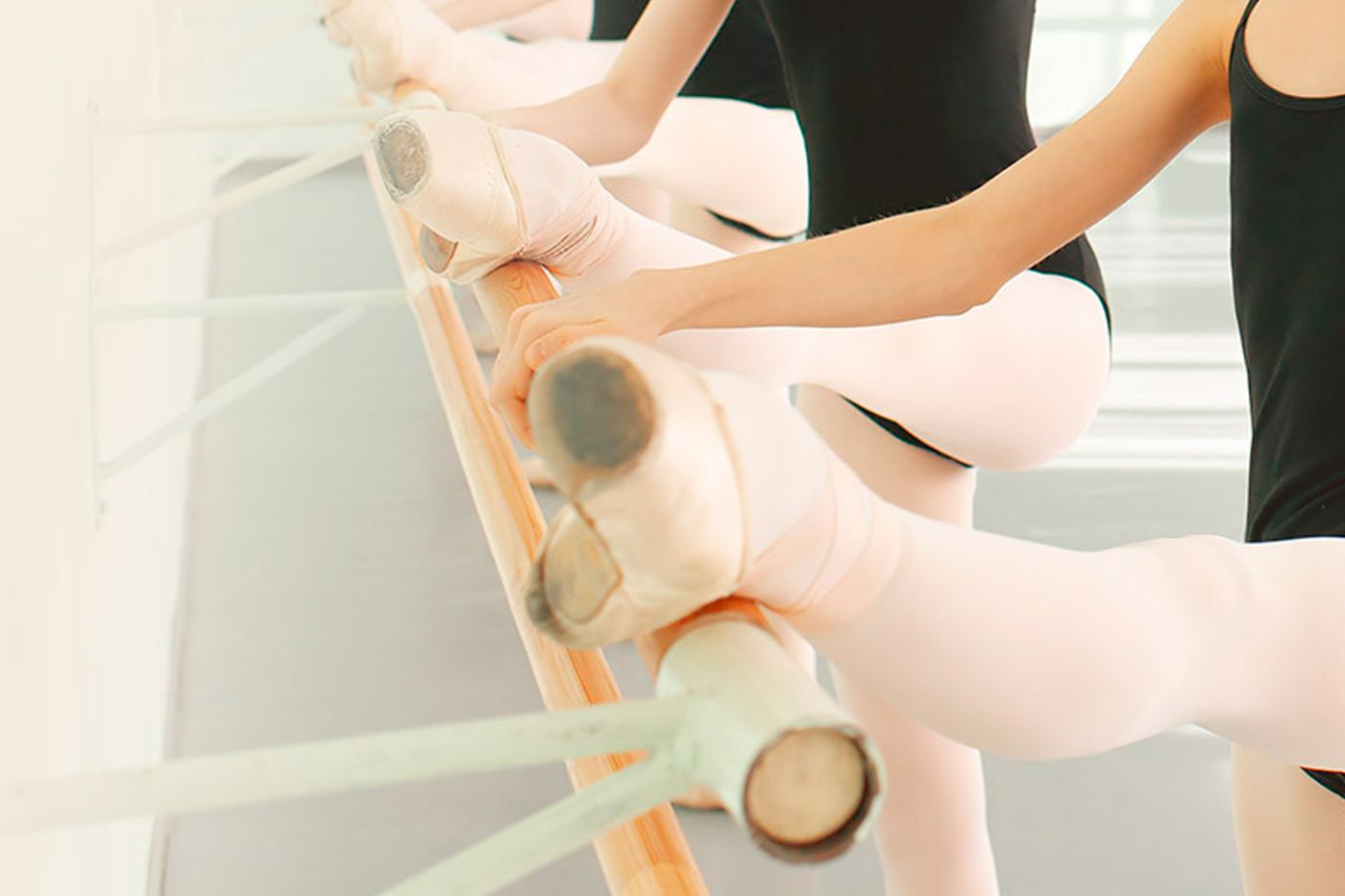
The next step: Pre-Professional 1
Ages 10 to 13. The pathway that leads to a dancer's training: five and a half to six hours per week, on Mondays and Wednesdays, with repertoire and, from the age of twelve, first pointe work.
Contact the school
Someone from the school will reply within one working day, through whichever channel you prefer. Opening hours: Monday to Friday, 5:00 pm to 9:30 pm.
- Emailschool@catballet.org
- Phone+34 93 83 52 053
- WhatsApp+34 649 958 497